
Shoreview City Directory Collections
The strongest local resource is not a digitized Shoreview volume at all. It is the Minnesota Historical Society Ramsey County telephone-directory finding aid. That finding aid catalogs Shoreview white-page and yellow-page material in print and fiche. The format and shelf reference sit right in the finding aid. The physical description becomes part of the evidence itself. The other collections add earlier Ramsey County context, regional comparison, or locally kept stories. None amounts to a current Shoreview resident lookup, and none should be treated as one.
| Collection | Years | Where held | Access |
|---|---|---|---|
| Shoreview telephone books | 1958–2011, with gaps and format variations | MNHS library finding aid | Request shelf or fiche material; white pages provide dated household and address leads |
| Minnesota state censuses | 1849–1905; the 1895 index includes Ramsey | MNHS People Search and Gale Family Library | Index and original image where linked; use county and spelling checks |
| MNHS birth, death, and people indexes | Birth 1900–1934; death 1904–2001, plus other sets | MNHS People Search | Historical lead only, not current residence proof |
| Saint Paul digitized directories | 1856–1922 | Saint Paul Public Library digital collection | Searchable regional comparison, not a Shoreview-specific run |
| Shoreview Historical Society material | Newsletters from 1991 onward; oral histories and Heritage Families | Lepak/Larson House and society resources | Contact the society for dated local narratives and donated records |
The MNHS telephone-directory finding aid is the source for this Shoreview historical-directory image.
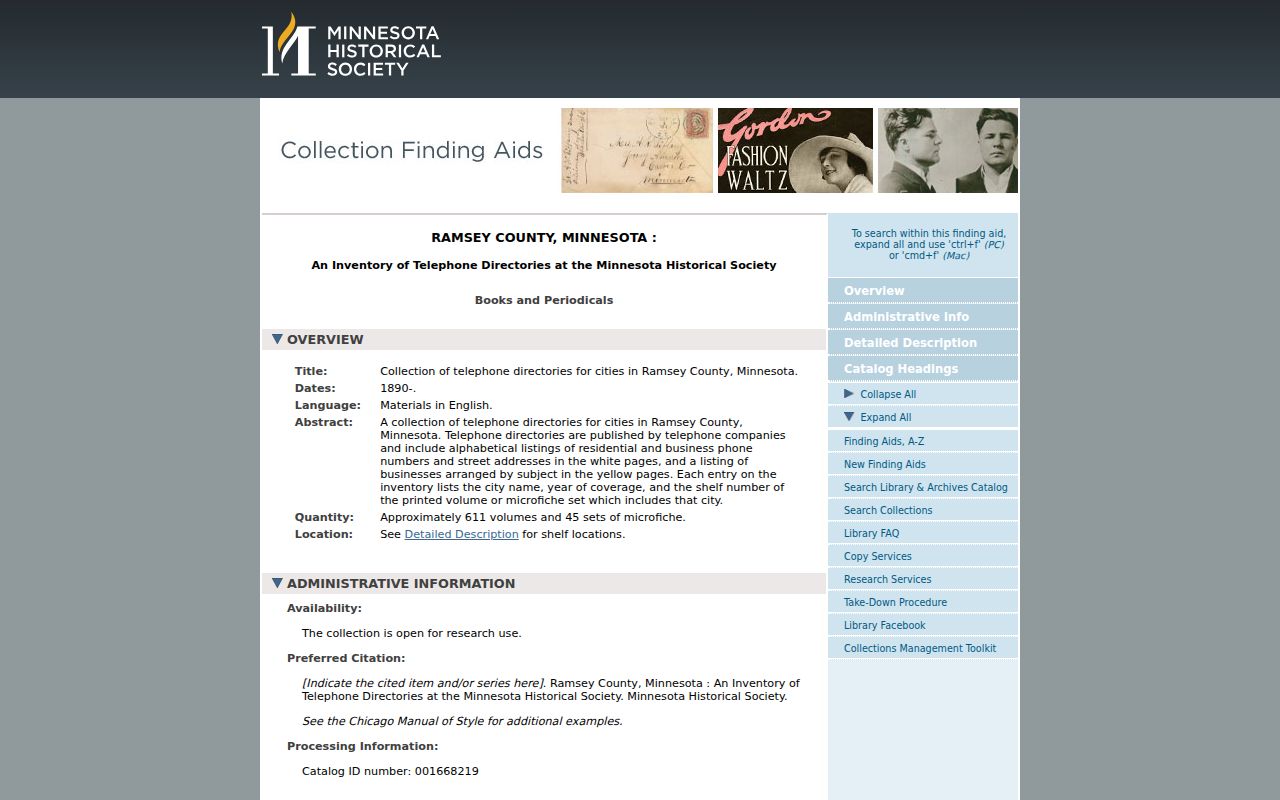
The finding aid marks the starting line. Use it to plan a physical or microfiche request rather than to assume every listed year exists as an online scan of the Shoreview residents directory.
Shoreview Directory Book Formats
Shoreview telephone holdings split into two parts. White pages run alphabetically by name. An entry there can carry a dated residential or business listing. It may include a phone number and street address. Yellow pages work differently. They group a business or service by subject. A yellow-page hit therefore proves a trade rather than a household. Several Shoreview years are yellow-only: 1960, 1961, 1962, 1968, 1985, 1987, 1988, and 2010. The finding aid also flags fiche-only examples for 1994 and 1995.
That format difference changes the question a lookup can answer. A white-page surname sitting at a dated street address is one kind of historical connection. A yellow-page line is simply a classification of a business. Note the exact year, volume type, and page. Do this before drawing any conclusion from the city directory. The listed person may be a head of household. The volume can leave out minors or anyone not independently listed in the residents directory.
- White-page entry
- An alphabetical residential or business telephone listing that can include a phone number and street address.
- Yellow-page entry
- A subject-arranged business or service listing, not a household listing.
- Shelf or fiche reference
- The finding-aid location needed to request the physical print or microfiche item from MNHS.
Note: A dated phone-book listing shows what the directory printed for that year, not a current address or every person in a family. Treat each entry as a snapshot.
Request a Shoreview City Directory Search
A shelf visit is not always practical. For those cases, MNHS offers a directory search request form. The form asks for a search type of City Directories, Telephone Books, or Both. It also wants a name, city or town, and year or years. Extra detail is optional. One request covers one person or business in up to five years within one city.
Fees are tiered. The service lists a nonrefundable $5 processing fee. A city-directory or telephone-book search costs $10. Both together cost $20. Scanning and email delivery are included. MNHS states a three-to-four-week turnaround that can stretch to 12 weeks. It also lists a member discount. Confirm the current form and charges before ordering from the MNHS directory-search page. Then label any returned result with the requested year so the Shoreview lookup stays traceable.
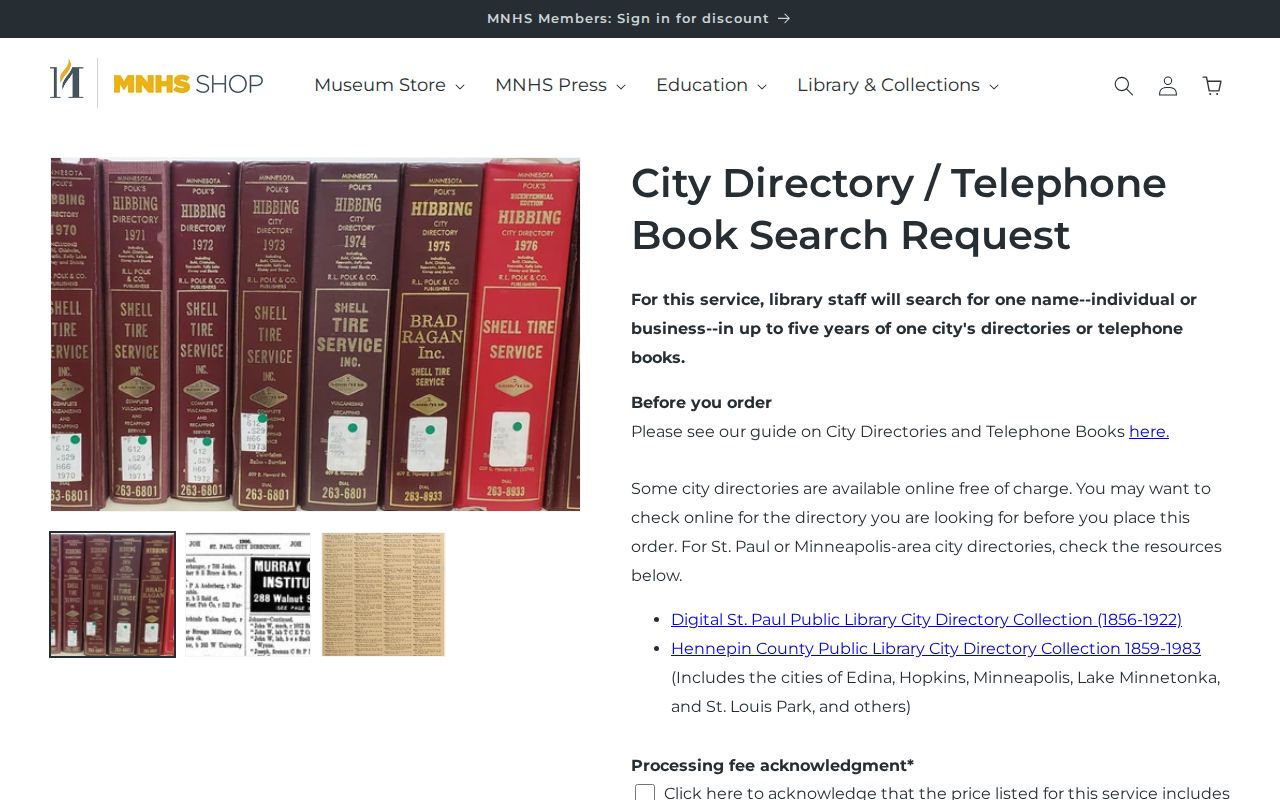
A staff search opens a door to physical holdings you cannot reach yourself. It is not a substitute for careful notes, though. Record the directory type and the year in every result.
Read a Shoreview City Directory Entry
Write down what the page actually says. Do not fill gaps from memory. For a real scan or a staff response, capture the directory title and year, the geographic scope, and the page number. Record the alphabetic section too. Then copy the exact name spelling and the listed head of household. Copy the street and number as well. Spouse initials, a telephone exchange or number, and a business classification belong in your notes only when they are printed. So does any cross-reference. These details make the entry checkable later. Another source may spell the name differently or give another address.
| Directory title and year | Identifies the dated source being used. |
|---|---|
| City or county scope | Shows whether the book actually covers the area being compared. |
| Page and section | Lets another researcher find the same alphabetical or subject entry. |
| Exact name and listed person | Preserves spelling and head-of-household convention without adding people not printed. |
| Street, number, and phone detail | Creates a dated location lead where the entry displays it. |
| Classification or cross-reference | Retains a business, service, or linking detail only if the volume contains it. |
MNHS notes that directories list families under a head-of-household convention. Women appear mainly when living independently, or when widowed or divorced. Minors are simply not listed. So a missing name may reflect editorial practice. It could also stem from confusion among common surnames, a different geography, or an incomplete telephone listing. The absence does not settle whether a person lived in the area.
Trace Shoreview City Directories Over Time
Build a household trail one dated item at a time. Start with the earliest telephone-book or directory entry you can locate. Follow that exact spelling forward through the later holdings. Treat each move, changed telephone listing, or missing year as a question. The next source answers it rather than forcing a conclusion. Minnesota's state-census sequence supplies useful older context. Keep in mind that the original record may use county, township, rural-route, lake, or neighboring-community geography instead of the later city name.
- Locate the first dated name or address in a Shoreview telephone holding and write down its white-page or yellow-page format.
- Check the next available directory year, rather than assuming every calendar year exists in the holdings.
- Compare street number, spelling, phone detail, and the listed person before treating two entries as the same household.
- Pair an older interval with the relevant Minnesota census material through MNHS People Search or the Gale Family Library, using county and family context to test common names.
- Close the dated trail with an official index, a historical-society narrative, or a record custodian when the evidence supports it, and keep the source date beside each finding.
Territorial censuses counted Shoreview-area settlers in 1849, 1850, 1853, 1855, and 1857, and the state followed with its own counts in 1865, 1875, 1885, 1895, and 1905. The 1895 index already includes Ramsey. Like a city directory or resident lookup, these rolls can reveal age, birthplace, and family context for past residents of Shoreview. When a transcription or name match matters, check it against the original image, since the street directory-era records hold details a copied index can drop.
Shoreview Historical Society Family Records
The Shoreview Historical Society fills in the human side of the record. A telephone listing never captures it. Its Lepak/Larson House materials include oral histories from long-time residents. They also include newsletters going back to 1991, an audio historical driving tour, photographs, artifacts, and the Heritage Families program. The Heritage Families stories trace Swedish, Croatian, Polish, Canadian, and French connections. Treat them as attributed local narratives rather than official proof of who lived where.
The Ramsey County Historical Society archival collections extend the reach across the region. Their finding aids cover church, association, newsletter, and permit records. A finding aid tells you whether a collection speaks to your Shoreview question. Check it before you submit a request. The society sits in Landmark Center in Saint Paul. Its contact information is 651-204-1283 and research@rchs.com.
The Ramsey County Historical Society archival collections page displays the Shoreview archival holdings described here.
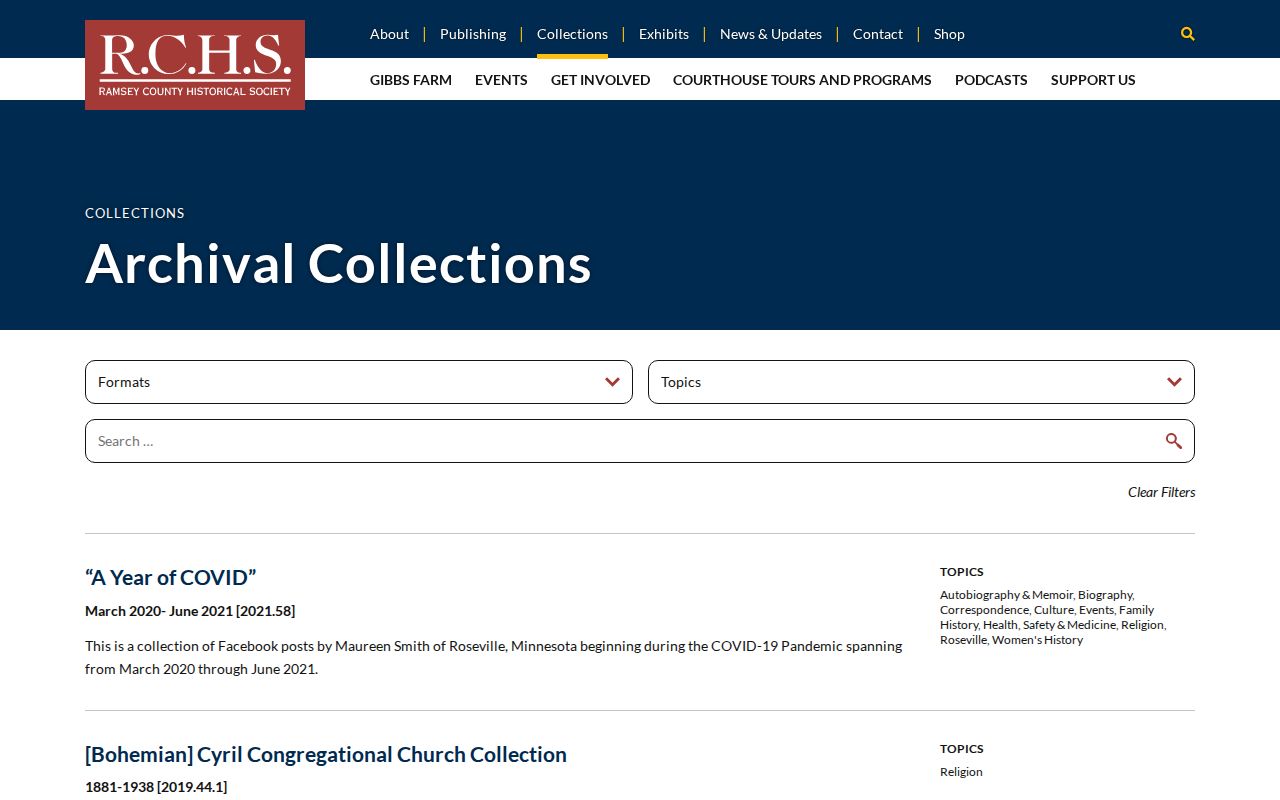
Keep the date and collection attached to every entry. Handled that way, narrative and archival sources can explain migration, family continuity, or a family's long hold on one Shoreview place.
Shoreview Directory Research Stops
The Ramsey County Library Shoreview branch handles the practical side of local research. It has computers, Wi-Fi, fax, and copiers. Study rooms, a scanner, and staff routing round out the support. The address is 4560 Victoria St N, Shoreview. Call 651-724-6006 for details. No special Shoreview directory collection appears there. The branch page names no city-directory, obituary, or house-history holdings, so ask staff for a current catalog or finding-aid route rather than assuming an unlisted volume is digitized.
The MNHS Gale Family Library at 345 W Kellogg Blvd in Saint Paul offers walk-in access to several historical databases. Its people and census resources draw many researchers. A directory question often turns into a state-census, vital-index, photograph, or map question. Recent Ramsey County Library system changes and Friday-closure notices make it worth confirming branch availability before any visit.
The Shoreview library branch page supplied this local-research image.
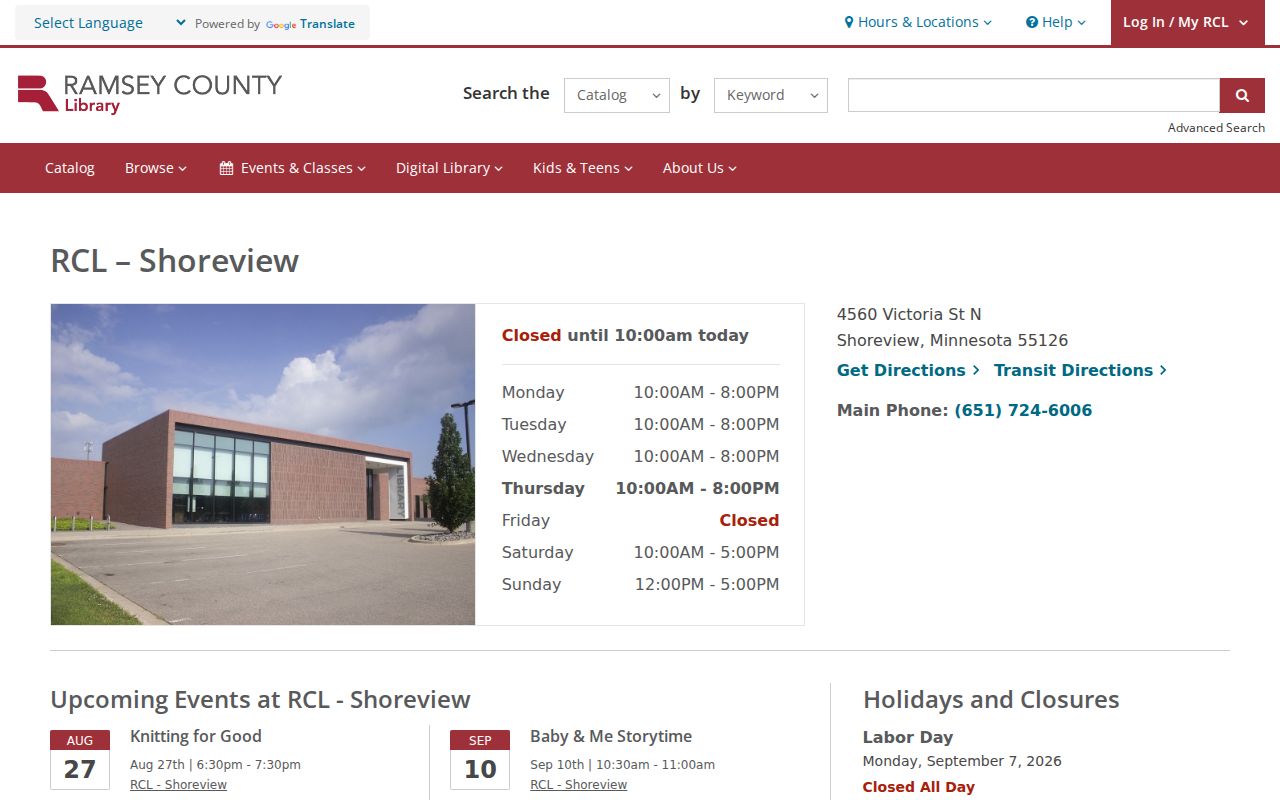
Libraries give you machines, rooms, and a staffed desk. The holding institution still owns responsibility for what its collection contains.
Shoreview Directory History
Shoreview records read differently against the city's shifting geography. A few markers help when you pick a directory year or search an older Shoreview geography.
- 1957: Shoreview incorporation was approved by voters, 853 to 748. Older people records may be filed under township, county, rural-route, lake, or neighboring-community terms.
- 1958: The earliest Shoreview telephone holding noted in the MNHS finding aid begins the documented local run.
- 1963: I-694 opened as the developing community moved from farms and lake cottages toward later subdivisions.
- 1974: Shoreview became a city by state act on January 1, and voters adopted Plan B council-manager government in November.
- 1991 onward: Shoreview Historical Society newsletters add a local memory layer to the directory and telephone evidence.
- 2011: The finding aid’s Shoreview telephone-book holdings run through this year, with gaps and format differences.
Free digitized Saint Paul directories work well for regional comparison. Shoreview itself publishes no digitized city-directory collection. Never relabel a Saint Paul scan as Shoreview coverage without checking the address and scope.
Limits of Shoreview City Directories
A telephone book documents a printed tie to a place at one stated time. It proves little else. Minors rarely appear. Whole family members can be missed, and an old entry says nothing about a present address or anyone's status today. Official sources offer no reverse directory for Shoreview. Ramsey County Library maintains no Shoreview obituary index, and no Shoreview-specific Sanborn sheet exists either. Those gaps point to an official reference desk or the documented MNHS holdings. They never justify inventing coverage.
A modern address question belongs elsewhere. Current parcel, map, permit, and recorded-document records carry that weight. The Shoreview street directory follows the address-record chain without rebuilding the historical shelf. So tie every finding to its source, date, format, and limitations.
Note: A directory entry is strongest when paired with another dated source. It should answer a different question.